Written by: Nevky Emiraj Saputra
In Sundanese philosophy, there is a saying: “Gunung nu mawa linuhung, leuweung nu dipitineung, cai nu mawa hurip”. This saying is not merely a beautiful string of words, but a worldview that places nature as an inseparable part of human survival. Mountains are seen as a source of glory, forests as spaces that must be protected and respected, while water is the source of life that must be preserved.
In the past, Sundanese society built a relationship with nature based on the principle of balance. Mountains were not viewed merely as spaces for exploitation, but as the foundation of life. Forests were treated with great care because they were believed to serve both ecological and spiritual functions. Water was revered because it is the origin of life: rice fields provide sustenance, rivers support social activities, and springs are the source of life.
However, looking at the situation today, a critical question arises: “Are those values still truly upheld?”
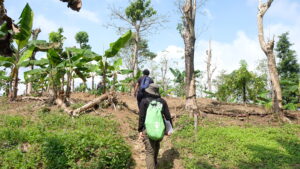
The reality in many parts of West Java shows that these noble values are facing a major test. Upland areas that were once green have now largely been converted into residential areas, villas, intensive plantations, and commercial zones. Mountain slopes are losing their vegetation cover. Forests that were once “pitineung” (cherished) are now being cleared without always considering ecological carrying capacity.
The most striking example can be seen along the Ciliwung River. The river’s once-serene upper reaches now face immense pressure due to land-use changes. As trees disappear, the soil loses its ability to absorb water. Rainwater that should seep slowly instead flows rapidly downstream, carrying sediment, trash, and increasing the risk of flooding in the lower (downstream) regions.
In fact, the meaning of “gunung nu mawa linuhung” today should be reinterpreted as a call to protect upstream areas as ecological strongholds. Mountains are not merely scenic tourist destinations, but the source of water, regulators of the microclimate, and guardians of hydrological balance.
The meaning of “leuweung nu dipitineung” is also increasingly relevant amid the threat of deforestation. Protecting forests does not merely mean banning logging, but ensuring that protective functions remain intact, rehabilitation is carried out, and land use aligns with nature’s carrying capacity.
Meanwhile, “cai nu mawa hurip” emphasizes that water must be viewed as a shared responsibility. In this context, water—once referred to as “mawa hurip”—is gradually issuing a warning. During the rainy season, water arrives as floods; during the dry season, water is hard to come by. Springs that once served as the lifeblood of communities are now experiencing reduced flow and pollution.
Therefore, the question “Are Sundanese values still being upheld?”—cannot be answered by cultural nostalgic sentiments alone. The answer to this question must be reflected in concrete actions such as preserving upstream forest cover, restoring rivers, limiting land exploitation, and placing ecology at the foundation of development.
In fact, Sundanese cultural values have not lost their relevance. In fact, amidst the climate crisis, floods, landslides, and water pollution, this philosophy has become increasingly important. What is needed is to revive it in everyday decisions, by the community, the government, the business sector, and the younger generation. For if the mountains lose their majesty, the forests lose their guardians, and the water loses its life, then what is lost is not just nature, but also our very identity.
In this context, collaborative efforts are now being directed toward this goal. The Ministry of Environment, together with the United Nations Development Programme (UNDP) Indonesia and PT Bhumi Pasa Hijau, believes that efforts to reduce flood risk in downstream areas cannot be separated from the protection of upstream areas. The river basin rehabilitation approach demonstrates that flood control is not merely about building infrastructure downstream, but also about restoring land cover, preserving forest functions, and strengthening the water absorption capacity of the landscape upstream.